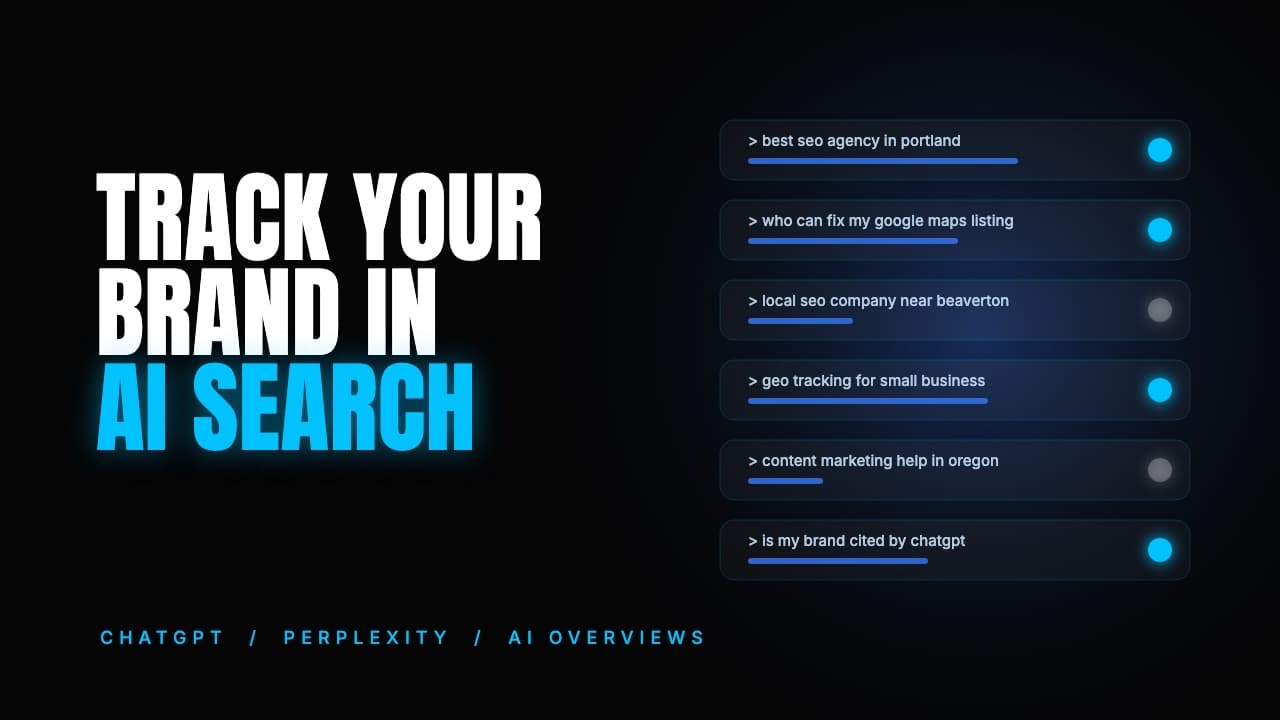
To measure AI search visibility, write a fixed list of 20 to 30 prompts your customers would ask, run them in ChatGPT, Perplexity, and Google on a schedule, and record four things for each answer: whether your brand is mentioned, whether your site is cited, which competitors appear, and how the answer describes you. A spreadsheet is enough to start. A paid GEO tracker earns its price only when you need more prompts or more frequent checks than you can run by hand.
What Should You Measure to Track AI Search Visibility?
Track four things: mentions, citations, share of voice, and sentiment. A mention means the AI names your brand. A citation means it links to your site. Share of voice compares your mentions with competitors across the list. Sentiment shows how the answer describes you.
| Metric | What it tells you | How to calculate it |
|---|---|---|
| Mentions | Whether the AI names your brand | Prompts that name your brand, divided by total prompts |
| Citations | Whether the AI links to your site | Prompts that cite one of your pages, divided by total prompts |
| Share of voice | How you compare with competitors | Your mentions, divided by all brand mentions across the list |
| Sentiment | How the answer describes you | Mark each mention positive, neutral, or negative, and check the facts |
Citations show which pages work. A citation is the link or source card attached to an answer. Note the exact page. Over time you learn which of your pages AI engines trust. Google says a page must be indexed and eligible to show in Search with a snippet to appear as a supporting link in its AI features.
Traffic is a check, not the main signal. Google says AI features are included in the overall search traffic in Search Console and reported under the Web search type. Its documentation does not describe a way to split them out. Use your prompt results as the main signal and traffic as a cross-check.
How Do You Build a Prompt List for GEO Tracking?
Start from real customer questions, not keywords. Pull them from sales calls, emails, reviews, and Search Console queries. Write each as a full question a person would type, add a local modifier where it fits, and keep the list fixed so results compare over time.
Cover four prompt types. Category prompts, such as "best accountant in Beaverton." Problem prompts, such as "why is my basement damp after heavy rain in Portland." Comparison prompts, such as "hiring a plumber vs doing it myself." Brand prompts, such as "is [your company] a good roofing company." Weight the list toward category and problem prompts, because buyers who do not know you yet ask those.
Add the local layer. Include the towns you serve. Run "in Hillsboro," "near Lake Oswego," and "in Portland" as separate prompts and compare the answers.
Freeze the list. Change prompts once a quarter at most, and note every change. If you rewrite prompts each month, you cannot tell whether your visibility moved or your questions did.
How Can You Track AI Visibility for Free?
Use a spreadsheet and a fixed monthly routine. Run each prompt in ChatGPT, Perplexity, and Google, record mentions, citations, competitors, and sentiment, then add your referral traffic from analytics. This free GEO checking method takes a couple of hours for 25 prompts.
Build the sheet. Use one row per prompt per engine. Add columns for date, engine, prompt, brand mentioned (yes or no), position in the answer, pages cited, competitors named, sentiment, and notes.
Use a clean session. Log out or open a private window, and start a new chat for each prompt. Saved history can shape answers. Record the engine, the date, and whether web search was on.
Run each prompt more than once. AI answers change between runs. Run each prompt two or three times and record whether you appeared in most runs instead of a single run.
Add traffic data. In Google Analytics, check Traffic acquisition by session source for visits from chatgpt.com and perplexity.ai. Treat the number as a floor. Ahrefs reported issues with ChatGPT not sending referral data, so some AI visits can show up as direct traffic.
Score it monthly. Calculate mention rate, citation rate, and share of voice, and compare them with last month. Write one sentence on what changed and one on what you will fix.
When Is Paid GEO Tracking Software Worth It?
Generative engine optimization tracking software pays off when manual checks stop being practical: more than 50 prompts, several locations or clients, daily runs, or reports for people who will not read a spreadsheet. Before that, a manual method costs nothing and teaches more.
You run out of hours. Fifty prompts across four engines, run three times each, is 600 checks. At that point a tool saves real time.
You do not appear anywhere yet. In that case a tool will report a score of zero every day. Spend the money on content and structured data first, then buy the tracker to prove the work paid off.
What to look for when you do buy. Check which engines it covers, how many prompts it runs, how often, whether it shows cited pages and named competitors, and whether you can export the data. Our tool comparison covers specific products and prices.
What Should You Do With the Results?
Fix the gaps the data shows. If you are not mentioned, publish clear answers to those prompts. If you are mentioned but not cited, improve the page the AI should link to. If facts are wrong, correct your profile, site, and listings.
Not mentioned. Build or improve pages that answer the prompt directly. This is the core of generative engine optimization: being the source an AI engine can use.
Weak answer format. Put a short, direct answer under each question heading. This is the center of answer engine optimization, and it helps readers as much as machines.
What Is a GEO Tracker?
A GEO tracker is a tool or spreadsheet that records whether AI engines mention and cite your brand for a set list of prompts. It measures visibility in answers from ChatGPT, Perplexity, Gemini, and Google AI Overviews. It does not change your results.
If you want help building your prompt list and reading the results, book a free 30-minute call. We will run the first round with you and show you what to fix.